
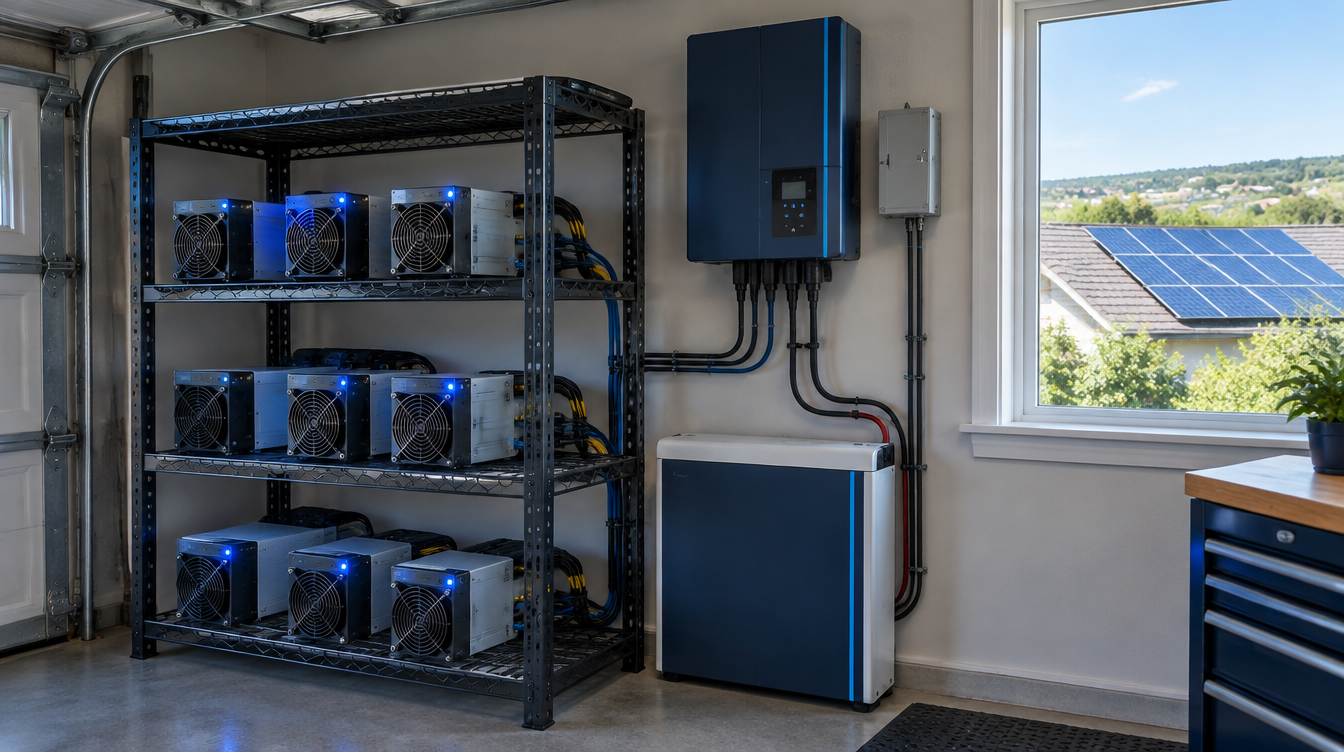

Information about physical hardware used for Bitcoin mining.
Here’s what it’s actually like to mine Bitcoin from home, the machines I use, and what beginners should know before getting started.
Start Here →What Is Hardware Mining?
Hardware mining means running physical machines (ASIC miners) that process Bitcoin transactions and earn BTC as a reward.
My Current Setup
I currently run a mix of different machines:
- Avalon Nano 3 miners
- Avalon Nano 3S miners
- Bitaxe (solo mining)
- Goldshell Byte (altcoin mining)
- Avalon Q
Each machine plays a different role depending on efficiency, power use, and strategy.
What My Setup Actually Earns (Updated August 6, 2026)
I only run my miners about 8 hours a day, because I power them with solar and don't want to pull from the grid at night. Here's what that actually earns in real dollars, using Bitcoin's price (~$64,400) and the network's mining difficulty as of today. These numbers move with the market and the network — treat them as a snapshot, not a promise.
- Avalon Nano 3: about $1.43/month on my 8-hour solar schedule
- Avalon Nano 3S: about $2.15/month on my 8-hour solar schedule
- Avalon Q: about $32/month on my 8-hour solar schedule
- Goldshell Byte: mines Aleo, not Bitcoin — right now it's barely breaking even, even on free solar power
- Bitaxe: solo mining, so there's no small daily payout at all — see below
Added together, the three Avalon machines bring in roughly $36/month running on my 8-hour solar schedule. That's genuinely small money — this isn't a way to get rich, it's a hobby that happens to pay for itself and then some.
The Bitaxe is different. It's solo mining, not pool mining, so there's no small steady payout. At its hashrate against the Bitcoin network's current ~816 EH/s, the honest math says it would take roughly 38,000 years of nonstop mining, on average, to find one full block by itself. If it ever hits, the prize is today's 3.125 BTC block reward plus fees — worth around $200,000 at current prices. I run mine because I enjoy being part of solo mining, not because I expect it to pay off.
To put "roughly 38,000 years" in perspective: winning the Powerball jackpot with a single ticket is about 1 in 292 million per drawing, and getting struck by lightning at some point in your life is about 1 in 15,300 over 80 years. My Bitaxe's odds of solo-finding a block on any given day are even longer than either of those. I don't run it expecting a payout — I run it because being part of solo mining is the fun part for me.
All numbers above are a snapshot as of August 6, 2026. Bitcoin's price and the network's mining difficulty change constantly, and mining income is never guaranteed — nothing here is a promise of what you'll earn.
Why I Use Multiple Miners
- Bitaxe → chance at hitting a full Bitcoin block (solo mining)
- Goldshell Byte → steady altcoin mining
- Avalon miners → consistent Bitcoin hashrate
- Avalon Q → higher power mining option
This gives me a mix of long-term upside and steady earning potential.
The Reality of Running Mining Hardware
Here’s what most people don’t tell you:
- Machines can break or stop working
- Support isn’t always easy to find
- Repairs can take time or fail completely
- You’ll need to troubleshoot issues yourself
A Real Problem I Ran Into
I sent one of my Nano miners to a repair center in Texas—only to have it sent back.
They couldn’t find the serial number in their system because it was built by a different company.
Pros of Hardware Mining
- Full control over your mining setup
- Long-term earning potential
- Hands-on experience with Bitcoin mining
Cons of Hardware Mining
- Upfront cost for machines
- Maintenance and repairs
- Electricity costs
- Downtime when issues happen
My Honest Take
Hardware mining is great—but it’s not the easiest way to start.
That’s why I don’t rely on hardware alone.
Want a Simpler Way to Start?
If you want to avoid setup, repairs, and downtime, there’s a simpler way to get started with Bitcoin mining.
See How GoMining Works →